
Current Trends: Barre — Why Add It to Your Studio Schedule Now
Barre was among the world's five most-booked fitness class types in 2025, with bookings growing by 30% year on year, according to ClassPass. For European Pilates and fitness studios, it also offers an opportunity to expand their class offering without investing in expensive exercise machines. A complete wall-mounted barre setup can cost roughly half as much as a single studio reformer. In this guide, we explore international fitness trends, insights from our own European sales data, equipment costs and practical lessons from running our own studios.
At a glance: Barre ranked as the fifth most-booked fitness class worldwide in 2025, with bookings increasing by 30% year on year, according to ClassPass. Our own sales data also points to growing interest: orders containing ballet and barre equipment across our five European online stores increased 6.5-fold between Q3 2025 and Q2 2026, relative to total orders. A wall-mounted barre setup for approximately ten participants starts at around €1,100, while a single professional Pilates reformer can cost several thousand euros. With flexible equipment options and access to instructor training, barre offers both established Pilates studios and new boutique fitness businesses an accessible way to expand.
What is barre and why does it matter for studios?
Barre is a group fitness workout inspired by ballet, Pilates and functional training. Classes typically combine small, controlled movements, high repetitions, bodyweight exercises and light equipment, using a ballet barre for support and balance.
Although barre has gained renewed attention in recent years, it is far from a new concept. Its origins date back to 1959, when dancer Lotte Berk opened her studio in London. Her student Lydia Bach later introduced the method to New York in 1971.
Today, barre has developed into an established boutique fitness format, offered by independent studios, Pilates businesses and international fitness chains.
Research into its potential health benefits is also emerging. Small studies have explored barre programmes among people with Parkinson's disease, older adults and women experiencing urinary incontinence. Some have reported encouraging outcomes, although larger studies are needed before firm conclusions can be drawn.
For studio owners, three characteristics make barre particularly interesting:
- Flexible class capacity. Unlike reformer Pilates, class capacity is not determined by the number of machines available. It depends primarily on floor space, barre length and safe participant spacing.
- Relatively low equipment costs. A typical class requires ballet barres, exercise mats and small accessories rather than large, expensive machines.
- A natural fit for Pilates clients. Barre and Pilates appeal to overlapping audiences, making barre a complementary addition to an existing class timetable.
Global trends and the European market
To understand barre's commercial potential, it helps to distinguish between online interest, actual class bookings and the wider fitness market.
Barre is among the world's most-booked fitness classes
According to the ClassPass 2025 Look Back Report, based on more than 40 million bookings, barre was the fifth most-booked fitness class type worldwide, with bookings growing by 30% compared with the previous year.
Pilates remained the leading category, recording 66% year-on-year growth.
Barre's position is not entirely new. It also featured among the five most-booked class types in the 2022 ClassPass and Mindbody report, suggesting sustained demand rather than a trend driven by a single successful season.
The growth of established fitness businesses provides further context. Pure Barre, one of the best-known international barre franchises, reported 625 open studios and 806 licences sold as of 31 December 2025, according to parent company Xponential Fitness.
These figures are not a direct measurement of European demand, but they demonstrate that barre has developed into an established commercial fitness category.
What does this mean for European studios?
Europe presents a diverse fitness market, with substantial differences in consumer spending, studio density, class pricing and participation rates between countries.
According to the European Commission's Special Eurobarometer on Sport and Physical Activity (2022), approximately 45% of EU respondents reported never exercising or playing sport.
Although this figure does not measure demand for barre specifically, it highlights the wider challenge and opportunity facing Europe's fitness industry: encouraging more people to participate in regular physical activity.
Barre may appeal to people looking for a structured group workout that combines strength, balance, coordination and controlled movement without the complexity of large exercise machines.
Examples of successful barre businesses are also emerging across Europe. In 2026, Forbes Czechia featured a Prague-based barre business operating two studios and reporting annual revenue of approximately CZK 12 million. Its experience illustrates how the format can develop into a dedicated boutique fitness business rather than simply an additional class on a studio timetable.
The important distinction: global booking statistics and individual European success stories indicate commercial potential, but they do not guarantee the same level of demand in every country or city. Local market research remains essential.
What our European sales data reveals
Publicly available statistics offer useful context, but we can also examine what is happening within our own business.
Flexity operates online stores across five European markets: Slovakia, Czechia, Hungary, Croatia and Romania. By analysing orders containing ballet and barre equipment, we can observe how purchasing patterns have developed across these markets.
Orders containing ballet equipment increased 6.5-fold. In Q3 2025, we recorded 21 such orders per 10,000 total orders. By Q2 2026, this figure had risen to 139.
Our data also reveals two distinct customer groups:
- Individual customers typically purchase one item, often for home use or personal training. The median order contains one item, with an average of 2.3.
- Business customers tend to purchase equipment for larger installations. The median business order contains three items, with an average of 5.5.
Larger purchases account for a considerable proportion of total sales. Orders containing 13 or more items represent just 8% of orders involving ballet equipment, yet account for 39% of all units sold.
This reflects a pattern we regularly encounter: customers are either purchasing an individual barre or investing in equipment for an entire studio.
Methodology: The figures are based on Flexity's internal sales data from five online stores operating in Slovakia, Czechia, Hungary, Croatia and Romania. The comparison covers Q3 2025 and Q2 2026, with order frequency calculated relative to 10,000 total orders.
Important limitation: Ballet barres were introduced to our product range in May 2025, with the first sale recorded in August 2025. The figures therefore describe the initial growth of a new product category within our business, not the overall growth rate of the European barre market. They should be interpreted as evidence of increasing demand within our customer base rather than a representative European market statistic.
What the international media says about barre
Barre has attracted attention from major fitness and lifestyle publications for many years. More recent coverage suggests renewed interest in the format, particularly among audiences already familiar with Pilates and boutique fitness.
| Publication | Article | Why it matters |
|---|---|---|
| SELF, December 2025 | Wellness Wrapped: The Workouts, Rituals, and Trends That Took Over 2025 | Highlights barre's position among the most-booked fitness classes in the ClassPass report. |
| Harper's Bazaar UK, January 2025 | Back to the barre: why it's time to revisit this ballet-inspired workout | Explores the renewed appeal of an established boutique fitness format. |
| Forbes, February 2025 | National Barre-Fitness Brand Barre3 Announces Acquisition Of Studio Barre | Reports on the acquisition of 11 Studio Barre locations by Barre3. |
| Women's Health, May 2025 | These Are All The Benefits You Get From A Barre Workout, According To Instructors | Examines barre's fitness benefits with input from instructors. |
| Marie Claire UK, March 2024 | As a long-time Pilates lover, I tried Barre for the first time and have some thoughts | Explores barre from the perspective of an existing Pilates enthusiast. |
| TIME, May 2017 | Why Barre Class Is So Good for Your Body | Shows that mainstream interest in barre extends well beyond the current fitness trend cycle. |
Taken together, these articles suggest that barre is not a short-lived novelty. It is an established workout format receiving renewed attention from consumers, instructors and fitness businesses.
How much does it cost to set up a barre studio?
One of barre's main commercial advantages is the relatively modest investment required for equipment.
Unlike reformer Pilates, which relies on specialised machines, barre classes can be organised using ballet barres, exercise mats and lightweight accessories.
The following examples are based on indicative prices from our product range, including VAT. Actual prices may vary by product variant, destination and applicable VAT rate.
| Setup | Equipment | Indicative investment |
|---|---|---|
| Wall-mounted barre studio for approximately 10 participants | 10 ARABESQUE wall supports and 5 wooden ballet barres | Approximately €1,100–€1,250 |
| Portable barre studio | Several free-standing ballet barres, depending on the model and room layout | Approximately €1,400–€3,200 |
| Permanent floor-mounted installation | Floor-mounted supports and wooden ballet barres | Depends on the room layout and installation requirements |
| Reformer Pilates studio, for comparison | 8 professional Pilates reformers | Approximately €19,000 or more for equipment alone |
Professional reformers can cost several thousand euros each. Industry software provider bsport estimates commercial reformer prices at approximately $3,000–$6,000 per machine, with total equipment budgets of $30,000–$60,000 for reformer studios.
For a studio considering a new group fitness format, this difference can be significant.
A complete wall-mounted barre setup may cost less than a single professional Pilates reformer. For comparison, explore the Elina Pilates Nubium Reformer 249 cm, a professional machine designed for studio use.
Barre also offers the flexibility to accommodate different group sizes, provided the studio has sufficient floor space and suitable barre installations.
Many established studios already own mats, resistance bands, small exercise balls and light dumbbells, reducing the need for additional purchases.
For detailed advice on equipment selection, read our guide to choosing and buying barre equipment. If you are considering reformer Pilates as an alternative or future expansion, our guide to buying Pilates machines covers the key factors to consider.
A simple revenue example
Consider a studio charging €12.50 per barre class.
- 8 participants per class generate €100 in gross revenue.
- 10 classes per week generate €1,000 in weekly gross revenue at full occupancy.
- Over four weeks, this represents €4,000 before operating costs.
This is an illustrative calculation, not a profit forecast. Instructor fees, rent, taxes, marketing, booking software and other operating expenses must be deducted. Actual revenue also depends on attendance and local pricing.
Nevertheless, the relatively low cost of equipment makes it possible to test the commercial viability of barre without committing to the investment required for a fully equipped reformer studio.
Two ways to introduce barre into your business
Scenario A: you already operate a Pilates reformer studio
For an established reformer studio, capacity is closely linked to the number of machines available.
Once classes are fully booked, expansion usually requires purchasing additional reformers, finding more floor space or introducing another workout format.
Barre offers a complementary option.
- Make better use of available space. Introduce barre during quieter periods or in a separate multi-purpose room.
- Offer additional class capacity. Accommodate clients who cannot secure places in popular reformer sessions.
- Encourage repeat visits. Give existing Pilates clients another workout option during the week.
- Introduce new customers to your studio. Barre can provide a lower-priced entry point for clients who may later explore reformer Pilates.
Rather than competing directly with reformer classes, barre can broaden the studio's offering and appeal to clients with different preferences and budgets.
Scenario B: you want to open a boutique fitness studio without reformers
Starting a reformer Pilates studio typically requires a substantial investment in machines, suitable premises and instructor training.
Barre offers a more accessible alternative for entrepreneurs who want to introduce boutique group fitness classes.
A suitable room, professionally installed ballet barres and basic exercise accessories can provide the foundation for a dedicated barre offering.
Portable equipment also makes it possible to use the same space for other activities, including yoga, mat Pilates, mobility and dance classes.
For a new studio, this flexibility can reduce financial risk and allow the business to test demand before investing in additional equipment or expanding its premises.
Explore our complete Ballet Barre equipment collection and compare free-standing ballet barres with wall-mounted options to find a suitable solution for your space.
Barre instructor training
Equipment is only one part of a successful barre business. Instructor quality plays an equally important role in creating a safe, engaging and consistent class experience.
Barre instructor training is available through various fitness education providers, dance organisations and specialist academies. Course duration, certification requirements and teaching qualifications vary between countries and providers.
Instructors with experience in Pilates, yoga, dance or group fitness may already possess useful skills in movement instruction, class structure and exercise modification.
At Flexity, we also support instructor education through our own training activities in Slovakia, including courses organised in cooperation with experienced barre instructors.
For studios operating elsewhere in Europe, we recommend checking local qualification requirements and choosing training that covers anatomy, technique, safe progression, class programming and practical teaching skills.
Practical advice: If you already employ Pilates or group fitness instructors, additional barre training may be a more efficient way to introduce the format than recruiting an entirely new teaching team.
Choosing the right equipment: why Dinamica Ballet
A ballet barre is one of the most important pieces of equipment in a barre class. Participants use it for balance, support and controlled movement throughout the workout.
Stability, durability and appropriate installation are therefore essential.
For our own studios and product range, we chose Dinamica Ballet, a Spanish manufacturer with roots dating back to 1976.
The company developed its first ballet barre in 2000 for Barcelona's Institut del Teatre and now supplies professional dance institutions, academies, theatres and sports facilities in more than 50 countries.
Its equipment is designed for professional use, making it suitable for dedicated barre studios as well as dance and fitness facilities.
Which type of ballet barre should you choose?
Explore our complete Ballet Barre equipment range, featuring professional equipment for dance schools, Pilates studios and boutique fitness businesses.
| Equipment category | Examples | Best suited to |
|---|---|---|
| Free-standing ballet barres | PRIMA, JULIETTE, AVANT, ISA, PINA, GISELLE | Multi-purpose studios and spaces requiring flexible layouts |
| Wall-mounted ballet barres | ARABESQUE wall supports with wooden barres | Space-efficient, permanent studio installations |
| Floor-mounted ballet barres | AVANT FIX, PINA FIX, ISA FIX, GISELLE FIX | Dedicated barre studios and professional dance facilities |
| Ballet barres and accessories | Wooden barres and compatible accessories | Completing an existing installation or equipping a new studio |
Portable double barres, such as PINA and GISELLE, offer two height levels and can accommodate participants of different heights. The GISELLE model also provides height adjustment.
Wall-mounted and floor-mounted supports are suitable for permanent installations, although the wooden barres are generally purchased separately.
When planning an installation, consider the available wall length, number of participants, safe spacing, mounting surface and whether the room will be used for other activities.
Our team can help you select suitable equipment and plan the layout of your barre studio, drawing on our experience equipping our own facilities.
Our experience: Flexity Studio
At Flexity, we do more than supply equipment. We also operate our own movement studios, giving us first-hand experience of the practical considerations involved in introducing barre classes.
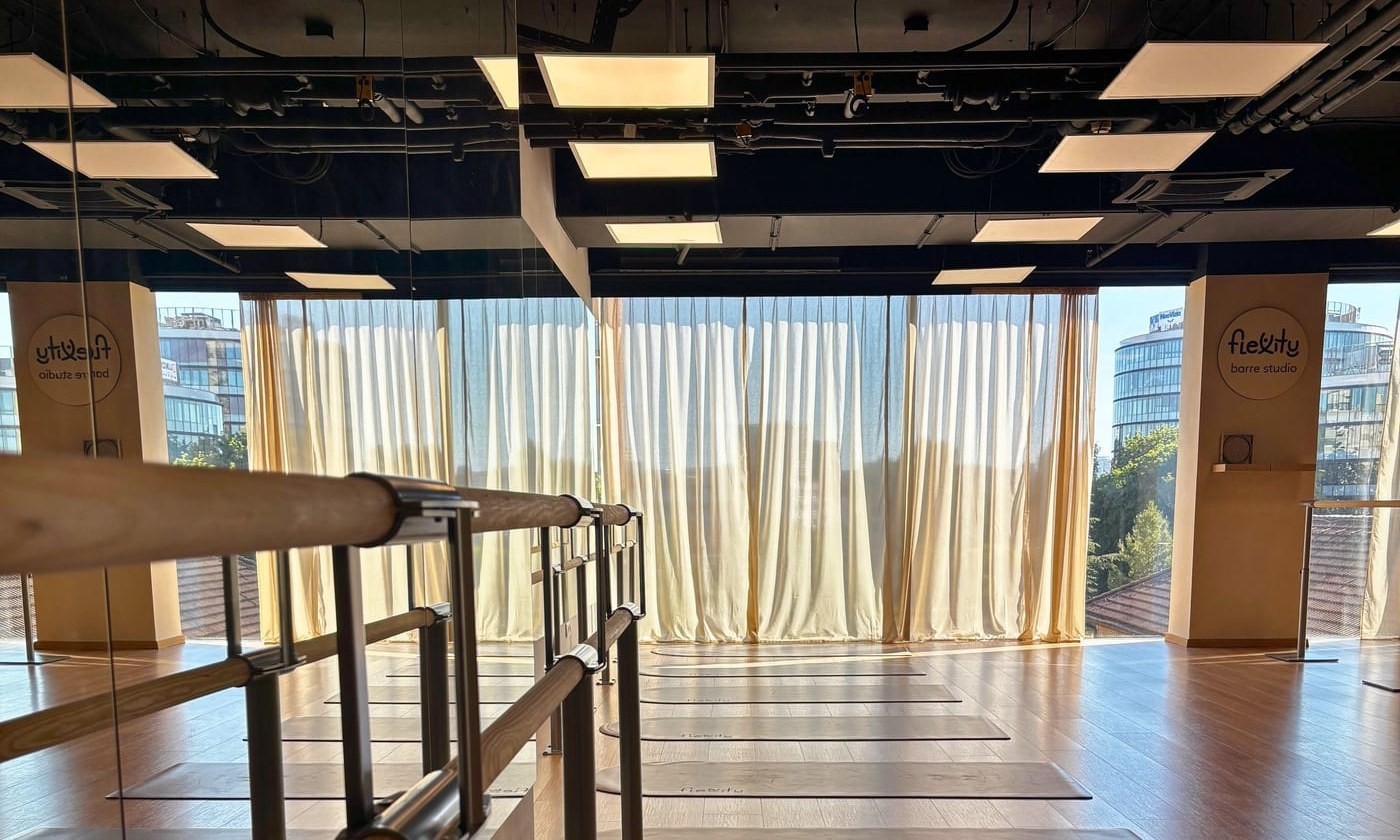
In 2026, we opened our barre studio in Bratislava, Slovakia, equipped with Dinamica Ballet barres.
Our class timetable includes different barre formats, from beginner-friendly sessions to more challenging workouts, alongside mat Pilates, stretching and ballet-inspired classes.
We also introduced barre classes at our studio in Poprad, Slovakia, in September 2026.
Operating in two different cities has reinforced an important lesson: the same workout format can require different pricing, scheduling and marketing strategies depending on the local market.
Our experience also highlights the value of offering several class formats, introducing new clients gradually and choosing equipment that suits the studio's available space.
For fellow studio owners, we are happy to share practical guidance on equipment selection, studio layouts and the considerations involved in launching barre classes.
Key takeaways for studio owners
- Barre was the fifth most-booked fitness class type worldwide in 2025, with bookings increasing by 30% year on year, according to ClassPass.
- Our own orders containing ballet equipment increased 6.5-fold between Q3 2025 and Q2 2026, relative to total orders across five European online stores.
- A wall-mounted barre setup for approximately ten participants can start at around €1,100, considerably less than the cost of equipping a reformer studio.
- Barre can complement existing Pilates services or provide an accessible starting point for a new boutique fitness business.
- Portable and fixed equipment options make it possible to adapt the format to different studio layouts.
- Our recommendations are informed by practical experience operating barre classes in Bratislava and Poprad.
Your first 90 days: a practical plan
If you are considering introducing barre to your studio, we recommend starting small and evaluating demand before making a larger investment.
- Weeks 1–2: assess local demand. Survey existing clients, create an interest list and consider organising a trial class with an experienced instructor. Focus on genuine booking interest rather than social media engagement alone.
- Weeks 3–6: organise instructors and equipment. Identify suitable training, evaluate your studio layout and choose between wall-mounted, floor-mounted or portable barres. Allow sufficient time for ordering, delivery and professional installation where required.
- Weeks 7–10: launch your first classes. Begin with two or three weekly sessions. Offer introductory packages, explain the format clearly and invite existing Pilates or fitness clients to try it.
- Weeks 11–13: measure performance. Monitor occupancy, repeat bookings, customer feedback and profitability. Adjust class times and pricing based on actual demand before expanding the timetable.
Understanding the risks: International booking trends and our own equipment sales data do not guarantee local demand. Studio performance depends on instructor quality, location, pricing, class scheduling, marketing and customer retention. A small pilot programme can help reduce uncertainty before committing to a larger investment.
Frequently asked questions
A wall-mounted barre setup for approximately ten participants can start at around €1,100, depending on the equipment selected. Portable barres and permanent floor-mounted installations have different costs. Mats and smaller accessories should also be included in the budget.
Not necessarily. Barre classes can take place in a suitable multi-purpose room already used for Pilates, yoga or dance. Portable ballet barres are particularly useful when the same space is used for several activities.
Training duration varies between providers. Some specialist courses take place over several days or weekends, while more comprehensive programmes may require additional practical training. Always check the qualification requirements applicable in your country.
Yes. Barre is a standalone fitness format that uses ballet barres, bodyweight exercises and light accessories. Professional reformer machines are not required.
Barre can complement reformer Pilates by offering a different workout experience and an additional price point. It may also help accommodate clients who cannot book popular reformer sessions.
Typical accessories include exercise mats, grip socks, light dumbbells, resistance bands and small exercise balls. The exact selection depends on your class programme.

Sources and references
- Global fitness booking trends: ClassPass, 2025 Look Back Report.
- Barre in the 2022 booking rankings: ClassPass and Mindbody report, Athletech News.
- Pure Barre studio and licence figures: Xponential Fitness, 2025 Annual Report, Form 10-K.
- Physical activity in the European Union: European Commission, Special Eurobarometer 525, Sport and Physical Activity, 2022.
- History of barre: Les Mills, Barre: Surprising Facts.
- Barre exercise overview: Cleveland Clinic, What Is Barre?.
- Barre clinical research: Haussler et al., 2026; Kim et al., 2025; Briskin & Luck, 2023.
- Reformer studio equipment costs: bsport, Equipment Costs and Class Size.
- European barre business example: Forbes Czechia, May 2026.
- Dinamica Ballet company history: Dinamica Ballet, About Us.
- Flexity internal sales data: combined results from five European online stores, Q3 2025 to Q2 2026.
- Flexity Studio: Bratislava and Poprad.