
Lagree, Megaformer and Pilates: What’s the Difference?
Lagree Fitness is a low-impact, high-intensity workout created by Sebastien Lagree on the specialized Megaformer machine. It is not Pilates, although it borrows some of its principles (movement control, springs, core engagement).This is why Lagree is often described as a “bridge” between Pilates and fitness. Main difference: Lagree = fitness intensity, Pilates = movement quality.
What is Lagree Fitness?
Lagree is a modern, low-impact yet very high-intensity workout developed by trainer Sebastien Lagree in the late 1990s in Los Angeles. It was created in response to the demand for training that strengthens the entire body, delivers visible results, and at the same time avoids jumping and harsh impact on the joints. From a professional standpoint, however, it is clear that Lagree is not Pilates. And Pilates is not Lagree.
Lagree vs Pilates – Key differences
Comparison table
| Criterion | Lagree (Megaformer) | Pilates (Reformer) |
|---|---|---|
| Intensity | High (time under tension) | Moderate (movement control) |
| Impact | Low-impact | Low-impact |
| Machine | Megaformer | Reformer (minimalist) |
| Goal | Body shaping, endurance | Stability, rehabilitation |
Philosophy and principles
At first glance, Lagree and Pilates may look similar – both methods work with controlled movement, springs, and core engagement. However, their goal and approach are different:
- Pilates: Movement quality, stability, conscious body engagement
- Lagree: Fitness intensity, long time under tension, body sculpting
Machines: Megaformer vs Reformer
Although Megaformer and Pilates Reformer may appear similar at first glance, they are two different machines, each designed for a different training philosophy. The Reformer is a classic Pilates apparatus. It consists of a solid frame with a single moving carriage, a footbar at the front, and a set of springs to adjust resistance.
Exercises are performed seated, lying down, or standing, with clearly guided and controlled movement. The Reformer supports precision, fluidity, and technical purity of movement. The Megaformer looks more robust from the outset. In addition to the central carriage, it has fixed platforms at the front and back, wide supports for hands and feet, side handles, and multiple pairs of springs that can be changed quickly.
This construction allows smooth transitions between exercises without stepping off the machine and keeps the muscles under tension even during transitions. The result is longer, more intense muscle work without explosive movements. A similar movement can be created on both machines, but each is built for a different type of muscular work. That is why we do not recommend confusing them. Exercising on a machine that looks like a Megaformer does not automatically mean it is Lagree.
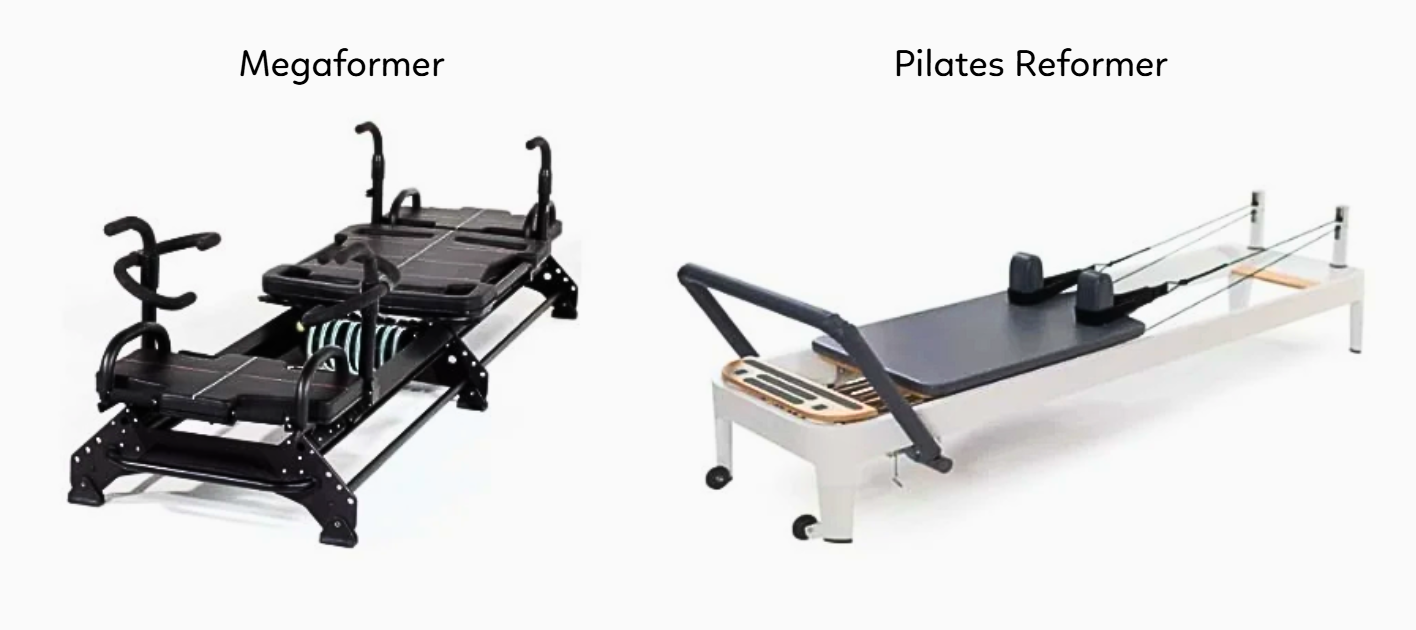
Comparison: Megaformer (left), Pilates Reformer (right)
Who is each method suitable for?
If the goal is rehabilitation, improved posture, or returning to movement after pain or a longer break, Pilates makes much more sense. It helps the body move consciously again, activate the correct muscles, and work with breath. It is often the first choice for back pain or during periods when the body needs more stability than intensity. If the goal is to visibly strengthen and reshape the body, build a strong core, and at the same time avoid jumping and hard impact, Lagree on the Megaformer is a very effective option. In practice, these workouts of course do not exclude each other. On the contrary, more and more people combine them depending on the current phase, energy level, and goals. And that is exactly what a modern approach to movement is about: respecting the body’s current needs rather than adapting to expectations or external pressure.
- Pilates (Reformer): Rehabilitation, posture, back pain, return after a break
- Lagree (Megaformer): Body sculpting, strong core, endurance without jumping
Many people combine both – Pilates for technique, Lagree for intensity.
What studies say
What is Time Under Tension (TUT)? A technique where muscles work longer under tension (45–90s) instead of short repetitions with weights. TUT increases muscle hypertrophy by 28% more than standard 8–12 rep training. Lagree style (long holds) activates slow-twitch Type I fibers + metabolic fatigue.
Technical specifications of the machines
| Parameters | Megaformer | Reformer |
|---|---|---|
| Dimensions | 296 x 63 cm | 255 x 60 cm |
| Springs | 8 pcs | 5–6 pcs |
| Weight | 220 kg | 80 kg |
| Price | €5,000+ | €2,500+ |
Lagree in Europe
- USA: 800+ licensed studios
- EU: 150+ studios, growth +42% YoY
- Slovakia/Czech Republic: studios (Bratislava, Prague, Brno)
- Forecast 2026: +25% in the CEE region
FAQ – Frequently Asked Questions
Yes, but the feeling will be different. The weights are lighter (or none), but the muscles work longer without breaks. Many are surprised that a “slow workout” can be more demanding than a fast one.
No. Lagree is a separate low-impact, high-intensity method with its own Megaformer machine. Pilates focuses on movement quality and stability.
No. They look similar but serve different types of training. Reformer = control and fluidity. Megaformer = long work under tension, more transitions.
Yes, if the class is properly led. Movements are slow, controlled, and can be adapted to current strength and fitness levels. Beginners often feel their muscles very quickly, but without jumping.
A marketing simplification. Professionally incorrect. Lagree is a licensed method, and not every workout on a similar machine is Lagree.
Sources
- Lagree Licensing (official)
- Lagree Academy
- Reformer Pilates benefits
- Reddit: Megaformer vs Pilates
- Lagree HABIT Studio
- Study: Pilates and posture
Did this article help you? If yes, you can also help someone else by sharing this page. You can also share your experiences in the comments below the article and help others.
Last updated: 29.12.2025